
Load bank testing is one of the most important—and most misunderstood—elements of industrial generator maintenance.
Many facility teams mistakenly assume that because the generator starts every Tuesday morning for its weekly exercise, the system is healthy. In reality, a standby generator can start perfectly, run for 20 minutes, and still fail catastrophically during a real outage if it cannot sustain a heavy electrical load.
In Texas, where generators often sit unused for long stretches and then face extreme weather events (like winter freezes or 105°F heat waves), verifying capacity—not just connectivity—is critical.
This guide explains the mechanics of load bank testing, the specific NFPA rules that dictate frequency, and why "Wet Stacking" is the silent killer of diesel engines.
Why No-Load Testing Isn’t Enough
Weekly or monthly "no-load" exercise tests are useful for keeping moving parts lubricated and verifying that the starter batteries work. However, these tests do not simulate the real operating conditions your generator will experience during an outage.
Think of it this way: A no-load test is like revving your car engine in the driveway. A load bank test is like driving that car up a steep hill while towing a trailer.
Common issues that no-load tests cannot detect include:
Carbon buildup in the exhaust system (Wet Stacking).
Cooling system failures (radiators often don't leak until they are hot and pressurized).
Fuel delivery restrictions (filters may flow enough for idle, but not for full power).
Voltage regulation instability.
Turbocharger lag or binding.
These hidden problems only appear when the generator is pushed to work hard.
Related Reading: Learn more about these hidden risks in our pillar guide: [Link to Blog 1: Why Generators Fail: Top 7 Early Warning Signs]
What Is Load Bank Testing?
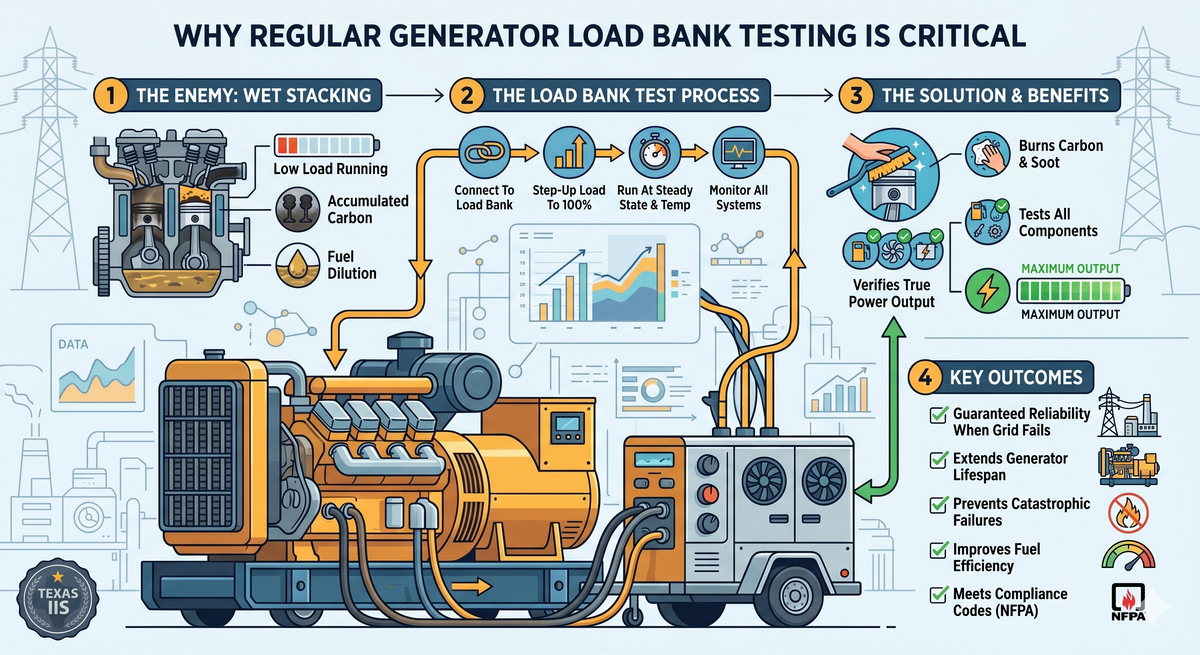
Load bank testing involves connecting an external device (the "load bank") to your generator. This device contains large heating elements that resist the flow of current, forcing the generator to produce power exactly as if it were powering your building's lights, HVAC, and machinery.
During a load bank test, technicians evaluate:
Voltage Stability: Does the voltage sag when a heavy load hits?
Frequency Control: Does the engine hold 60Hz steady?
Cooling Performance: Does the thermostat open and the radiator shed heat effectively?
Exhaust Clarity: Does the smoke clear up as the engine gets hot?
Wet Stacking Explained (With a Simple Analogy)
Wet stacking is the primary reason diesel generators require load testing. It occurs when diesel engines run at low loads (light idling) for extended periods. Because the engine never gets hot enough, unburned fuel and soot accumulate in the exhaust system and cylinders.
The "Sports Car" Analogy Imagine you own a high-performance sports car, but you only ever drive it at 10 mph in a school zone. Over time, the spark plugs foul, carbon builds up on the valves, and the engine becomes sluggish. A diesel generator is designed to work hard. When it "babies" a light load, it creates "slobber"—a thick, dark goo of unburned fuel that leaks from the exhaust manifold.
Consequences of Wet Stacking:
Reduced power output.
Increased pollution and black smoke.
Permanent cylinder damage (glazing).
Fire risk in the exhaust stack.
Load bank testing raises the engine temperature high enough to burn off this accumulated carbon, effectively "cleaning out the arteries" of the engine.
Related Reading: Fuel quality plays a huge role in how fast wet stacking occurs. Read more in: [Link to Blog 5: How Fuel Quality Affects Generator Reliability]
How Often Should Industrial Generators Be Load Bank Tested?
Frequency depends on how you use your generator, but NFPA 110 provides the baseline rules.
1. The "30% Rule" (Monthly vs. Annual)
NFPA 110 (Chapter 8) states that diesel generators must be loaded to at least 30% of their nameplate rating during their monthly exercise.
Scenario A: Your generator exercises monthly, but the automatic transfer switch doesn't transfer the building load. The generator runs with zero load.
Result: You MUST perform an annual load bank test to comply with NFPA standards.
Scenario B: Your generator exercises monthly, and you have enough emergency lighting and HVAC load to push it past 30% capacity.
Result: You may not need an annual load bank test, though it is still recommended for diagnostics.
2. Quarterly Testing for Mission-Critical Facilities
Facilities that cannot tolerate even a momentary dip in power—such as data centers, hospitals, or large industrial freezers—often schedule quarterly load banking. This ensures that the complex fuel and cooling systems are verified more frequently than just once a year.
3. After Major Repairs
Any maintenance that touches the fuel, air, or combustion systems should be validated with a load test.
Injector replacement.
Turbocharger repair.
New piston rings or cylinder heads.
Major cooling system overhauls.
4. Before Texas "Peak Seasons"
In Texas, we have two peak seasons: Summer Heat and Winter Freeze. Scheduling a load bank test in April/May (pre-summer) or October/November (pre-winter) ensures your unit is ready for the extreme stress of the coming season.
What Happens During a Proper Load Bank Test?
A professional load bank test isn't just "turning it on." It is a structured engineering procedure.
Step 1: Connection & Safety Technicians connect heavy-gauge cables from the load bank to the generator's distribution breaker. If your facility has a Cam-Lock docking station, this takes minutes. If not, tails must be safely tied into the lugs.
Step 2: The Step-Load Process We don't slam the generator with 100% load instantly. We step it up:
0-15 Minutes: 25% Load (Warm up)
15-30 Minutes: 50% Load (Verify temperatures rising)
30-45 Minutes: 75% Load (Check fuel pressure)
45-60+ Minutes: 100% Load (Full capacity verification)
Step 3: Cool Down Before shutting down, the load is removed gradually to allow the turbocharger and engine block to cool evenly, preventing thermal shock.
Related Reading: If the generator fails to hold load, the ATS is often the next component to check. Read: [Link to Blog 4: ATS Failure Points and How to Identify Them]
How Load Bank Testing Reduces Facility Risk
Compliance: It satisfies NFPA 110 requirements for units that don't hit 30% load monthly.
DPF Regeneration: For newer Tier 4 Final generators, high heat is required to clean the Diesel Particulate Filter (DPF). Without load banking, these units will clog and shut down.
Proof of Capacity: It provides a printed report proving your generator can handle the building's load—essential documentation for insurance audits and fire marshals.
Related Reading: This test is a key part of our broader risk strategy. Learn more: [Link to Blog 6: What a Generator Downtime Risk Assessment Includes]
Conclusion
Load bank testing is the only way to prove your generator can actually do its job.
A generator that starts but cannot hold load is a liability, not an asset. Annual tests—and strict adherence to the NFPA "30% Rule"—help detect issues early, scrub carbon from the engine, and ensure that when the Texas grid falters, your lights stay on.
Don't guess about your capacity. If you need to evaluate your testing schedule or book a seasonal load bank test, reach out to the professionals at Texas Industrial Infrastructure Services