
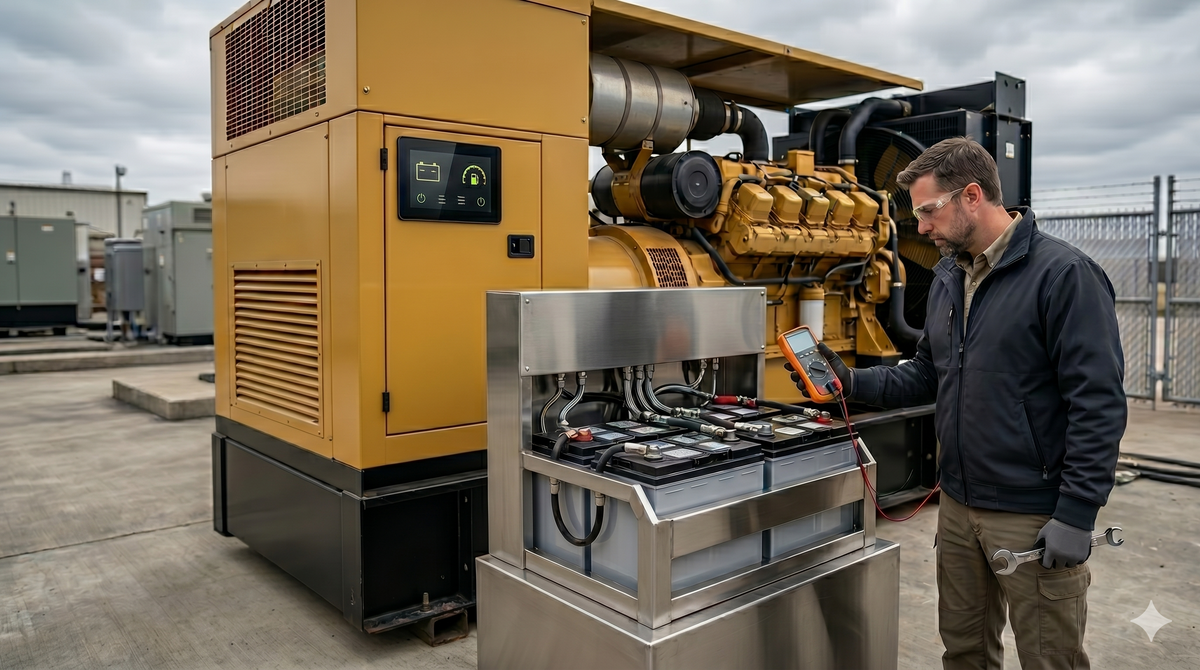
A generator can be in excellent mechanical condition, with a full tank of clean fuel and a brand-new engine… but if its batteries fail, it becomes a 10,000-pound paperweight.
That simple truth makes batteries one of the most critical—and most overlooked—components of any standby power system. Across Texas industrial and commercial facilities, battery-related failures consistently remain the #1 cause of emergency generator no-start events.
Because batteries degrade quietly and often show no visible symptoms until the moment of failure, understanding why they fail and how to maintain them is essential for facility managers responsible for uptime.
This expanded guide explains the chemistry behind battery failure, why Texas heat is the ultimate battery killer, and how to manage a maintenance program that ensures your generator starts the first time, every time.
Why Batteries Matter More Than You Realize
Generators require a massive burst of amperage to crank a cold diesel engine. We aren't talking about starting a Honda Civic; we are talking about turning over a 12, 16, or 20-cylinder industrial engine that has high compression and heavy internal friction.
The "Gatekeeper" of Power The battery is the gatekeeper. If its output drops even slightly below the required Cold Cranking Amps (CCA), the generator controller will abort the start sequence to protect the starter motor.
The Result: The lights stay off, and the facility goes dark.
Related Reading: Battery failure is the first item on our list of major risks. Read: [Link to Blog 1: Why Generators Fail: Top 7 Early Warning Signs]
Why Generator Batteries Fail: The Real Causes
Battery failure is rarely random. It is the result of chemistry and physics. Here are the primary contributors to failure in the Texas market:
1. Heat Exposure Accelerates "Chemical Suicide"
Texas heat is the enemy of lead-acid batteries. Inside the battery, a chemical reaction produces electricity. Heat acts as a catalyst for this reaction. For every 15°F rise in operating temperature above 77°F, the battery's life expectancy is cut roughly in half.
Practical Impact: A battery rated for 5 years in a climate-controlled data center in Minnesota might only last 24 months inside a hot metal generator enclosure in Houston or Dallas.
2. Sulfation: The Silent Killer
Generators spend 99% of their life sitting still. The batteries are kept on a "float charge" (constant voltage). If a battery sits slightly undercharged for too long, sulfur crystals form on the lead plates. These crystals harden over time (sulfation), permanently reducing the battery's ability to hold a charge.
3. The "Charger" Factor
Often, the battery isn't the problem—the charger is.
Overcharging: If the charger's "float voltage" is set too high, it boils the electrolyte out of the battery, warping the plates.
Undercharging: If the charger is weak, sulfation takes over.
Electrical Noise: Old chargers can send "dirty" DC power that damages the battery's internal chemistry.
TIIS Pro Tip: We treat the Battery and Charger as a single system. You cannot fix one without checking the other.
4. Corroded Terminals (The "Green Crust")
Lead-acid batteries release small amounts of hydrogen gas. This gas reacts with the copper or lead terminals to create corrosion (that white/green powdery buildup). The Risk: Corrosion acts like a resistor. The battery might have full power, but the corrosion blocks the current from getting to the starter.
Early Warning Signs of Battery Failure
Batteries usually provide subtle indicators of declining health before they die completely. Facility teams should watch for:
1. The "Slow Crank"
Listen to your generator during its weekly exercise. Does it sound "lazy"? Does it take 3-4 seconds to fire instead of the usual 1-2 seconds? Do not ignore this. A slow crank is the battery screaming for help.
2. Dim Control Panel Lights
When the starter engages, it draws massive current. If the control panel LCD screen dims significantly or flickers during cranking, the battery voltage is sagging dangerously low.
3. Low-Voltage Alarms
Modern generator controllers are smart. If you see a "Low Battery Voltage" or "Pre-Low Battery" alarm in the event log, the system is telling you that the charger is struggling to keep up.
Related Reading: Reviewing these logs is a key part of our assessment process. Read: [Link to Blog 6: What a Generator Downtime Risk Assessment Includes]
How Generator Batteries Should Be Tested
"My multimeter says 12 Volts, so it's fine." We hear this all the time, and it is wrong. A dead battery can still show 12+ volts on a multimeter (Surface Voltage). It fails only when you ask it to do work.
The TIIS Testing Protocol:
Load Testing: We use a Carbon Pile Load Tester to simulate the massive current draw of a starter motor. If the voltage crashes under load, the battery is bad—no matter what the multimeter says.
Specific Gravity: For non-sealed batteries, we measure the density of the acid to check the health of each individual cell.
Conductance Testing: A digital analysis that measures the internal resistance of the plates.
Related Reading: Ensuring the battery can hold load is critical for ATS operation too. Read: [Link to Blog 4: ATS Failure Points and How to Identify Them]
How Often Should Generator Batteries Be Replaced?
The "24-Month Texas Rule" While many batteries carry a "3-Year Warranty," waiting for them to fail is a bad strategy for critical infrastructure. Given the extreme heat in Texas, TIIS recommends a proactive replacement cycle:
Outdoor Enclosures: Replace every 24–30 months.
Indoor / Climate Controlled: Replace every 36–48 months.
The cost of a new battery is a fraction of the cost of a single failed start during a blackout.
Environmental Factors Unique to Texas
Thermal Cycling: Going from 100°F in the day to 70°F at night causes the battery case to expand and contract, loosening the internal connections.
Vibration: Industrial generators vibrate heavily. If the battery hold-down brackets are loose, that vibration will shake the internal lead plates apart.
Related Reading: Batteries aren't the only thing affected by the environment. Read: [Link to Blog 5: How Fuel Quality Affects Generator Reliability]
Operational Impact of Battery Failure
When a battery fails, it triggers a cascade of problems:
No-Start: The generator fails to run.
ATS Lockout: The transfer switch may get confused by low voltage signals.
Controller Reset: Low voltage can wipe the generator's internal clock or exercise schedule.
Starter Damage: Low voltage causes high heat in the starter solenoid, potentially burning out the starter motor itself.
Related Reading: This ties directly into compliance readiness. Read: NFPA 110 vs NFPA 70B: What Facility Managers Need to Know
Conclusion
Battery failure is the most common cause of generator no-start events—not because batteries are unreliable, but because they are often ignored.
In Texas, where heat kills batteries rapidly, an "install it and forget it" mentality is a recipe for disaster. Routine load testing, charger verification, and a proactive 24-month replacement schedule are the only ways to guarantee your generator will start when the grid goes down.
Don't let a $300 battery ruin your $100,000 generator investment.
If you’d like help evaluating the condition of your batteries or verifying your charger output, reach out to the professionals at Texas Industrial Infrastructure Services.