
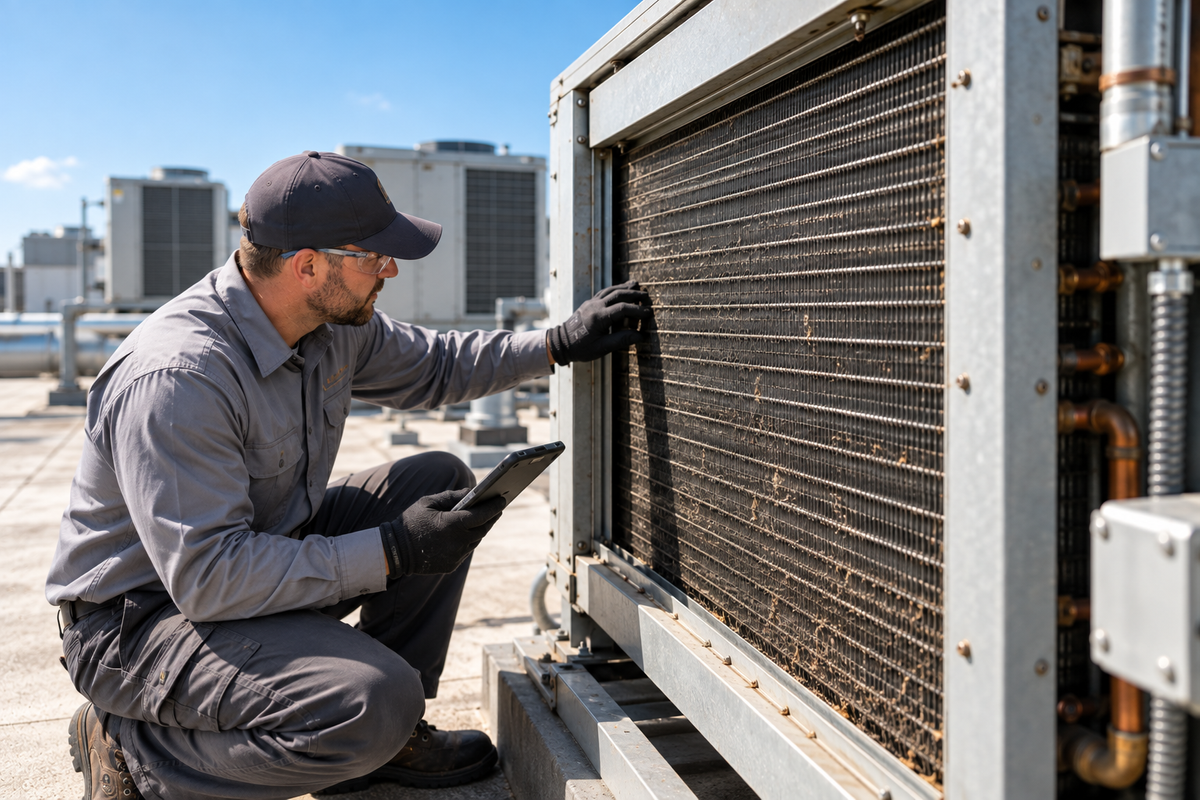
“How often should we clean the coils?”
It sounds like a simple maintenance question. For commercial and industrial HVAC systems, however, there is no single cleaning schedule that works for every facility.
A rooftop unit operating next to a cottonwood-lined property may accumulate debris very differently from an air handling unit inside a controlled commercial building. Manufacturing processes, construction activity, filtration, operating hours and environmental conditions can all affect how quickly a coil becomes contaminated.
That is why commercial HVAC coil maintenance should be based on equipment condition and operating environment, not simply a date on the calendar.
Guidance from the U.S. Department of Energy recommends checking evaporator and condenser coils regularly and cleaning them when necessary to prevent dirt from restricting airflow, insulating coil surfaces and reducing efficiency.
For facility managers, the better question is not simply, “How often should coils be cleaned?”
It is, “How quickly are our coils becoming contaminated, and when is that contamination beginning to affect performance?”
Why Commercial HVAC Coils Need Regular Inspection
Condenser and evaporator coils are heat exchangers.
Their ability to transfer heat depends partly on air moving effectively across coil surfaces. When dust, pollen, cottonwood, grease and other contaminants accumulate, they can interfere with that process.
ENERGY STAR recommends cleaning evaporator and condenser coils on heat pumps, air conditioners and chillers because dirty coils can inhibit heat transfer.
The effects can develop gradually.
A contaminated coil may contribute to:
- Restricted airflow
- Reduced heat transfer
- Longer equipment run times
- Reduced cooling capacity
- Increased equipment strain
- Higher energy consumption
- Difficulty maintaining building temperatures
Because equipment may continue operating while these conditions develop, visual inspection and preventive maintenance become important tools for identifying problems before they become more disruptive.
Is Annual Coil Cleaning Enough?
An annual inspection can provide a useful baseline, but an automatic once-a-year cleaning schedule may be too frequent for some equipment and not frequent enough for others.
Commercial facilities can operate under dramatically different conditions.
A facility manager should therefore distinguish between inspection frequency and cleaning frequency.
Those are not necessarily the same thing.
An inspection helps determine whether contamination has reached the point where cleaning is warranted. Over time, those inspection records can help establish a more appropriate maintenance interval for each facility or equipment type.
What Determines How Quickly HVAC Coils Get Dirty?
Several factors can significantly affect coil-cleaning frequency.
Equipment Location
Outdoor condenser coils are exposed directly to the surrounding environment.
Equipment near vegetation may encounter pollen, leaves and cottonwood. Urban or industrial properties may experience dust, exhaust or airborne particulate. Rooftop equipment can also be affected by nearby construction activity.
Two buildings only a few miles apart can therefore have very different coil-maintenance requirements.
Facility Type
A commercial office, manufacturing facility, warehouse, school and data center do not operate under identical conditions.
Manufacturing and industrial environments may generate airborne contaminants that accelerate buildup.
Warehouses may experience dust from loading activity and vehicle traffic.
Facilities with demanding cooling requirements may also operate equipment for significantly longer periods.
The maintenance strategy should reflect the environment in which the equipment actually operates.
Filtration
Filtration plays an important role in protecting indoor HVAC components.
Poor filter maintenance, incorrect filter installation or air bypass around filters can allow additional contamination to reach evaporator coils.
That makes filter condition and coil condition related maintenance issues rather than completely separate tasks.
Operating Hours
Equipment that runs extensively has more opportunities to move contaminated air across coil surfaces.
In North Texas, long cooling seasons can mean substantial operating hours for commercial HVAC equipment.
Facilities with 24/7 operations may face an even greater maintenance demand.
Nearby Construction
Construction and renovation can introduce unusually high levels of dust and debris into the environment.
If significant construction occurs near HVAC equipment, facility teams should consider inspecting coils afterward rather than simply waiting for the next regularly scheduled maintenance event.
Previous Maintenance
Maintenance history matters.
If a facility has limited documentation showing when coils were last inspected or cleaned, establishing a baseline condition is a logical first step.
TIIS's commercial HVAC coil cleaning service begins with an assessment of coil condition, contamination, fin condition, accessibility and site requirements before determining the appropriate cleaning approach.
Condenser and Evaporator Coils May Need Different Schedules
A facility should not automatically assume that every coil needs to be cleaned at the same interval.
Condenser Coils
Because condenser coils are generally exposed to outdoor conditions, contamination can sometimes accumulate relatively quickly.
Common sources include:
- Cottonwood
- Pollen
- Dust
- Leaves
- Landscaping debris
- Construction debris
- Industrial airborne contaminants
Visual inspection can often reveal significant surface contamination, although some coil configurations can trap debris deeper within the coil.
Evaporator Coils
Evaporator coils operate in the conditioned-air side of the system and are typically protected by filtration.
That does not mean they remain clean indefinitely.
Particles that pass through or around filtration can accumulate on coil surfaces over time. The U.S. Department of Energy notes that dirt on evaporator and condenser coils can reduce airflow, insulate coil surfaces and reduce efficiency.
The appropriate inspection and cleaning schedule should therefore account for both the equipment type and the environment.
What Are the Signs a Commercial HVAC Coil May Need Cleaning?
Facility teams should not wait for complete equipment failure before investigating coil condition.
Potential warning signs include:
- Visible dirt or debris on coil surfaces
- Cottonwood or organic material covering outdoor coils
- Restricted airflow
- Longer-than-normal equipment run times
- Difficulty maintaining temperature
- Declining cooling performance
- Unexplained changes in HVAC energy consumption
- A history of deferred coil maintenance
These conditions can have causes other than dirty coils, so inspection should come before assuming cleaning will solve the problem.
That distinction is important.
Professional coil maintenance should begin with understanding what is actually happening with the equipment.
Build an Inspection-Based Maintenance Schedule
Instead of choosing an arbitrary cleaning interval, facility managers can use inspections to establish a maintenance schedule based on actual conditions.
A practical approach is to:
- Establish the current condition of the coils.
- Document the level and type of contamination.
- Clean coils when conditions warrant it.
- Record before-and-after conditions.
- Reinspect at an appropriate interval.
- Compare the new condition with previous documentation.
- Adjust future inspection and cleaning intervals accordingly.
Over time, this creates a facility-specific maintenance history.
That information is much more useful than assuming every coil should receive exactly the same service at exactly the same interval.
Documentation Makes the Maintenance Schedule Better
Coil maintenance should produce more than a completed work order.
TIIS documents coil-cleaning projects with before-and-after photographs, observed coil condition, the cleaning method used, identified deficiencies, recommendations and maintenance priorities.
That documentation can help facility teams determine whether contamination is recurring quickly, identify equipment that requires more frequent attention and make better-informed preventive-maintenance decisions.
This follows the same principle behind a broader preventive-maintenance program: documented equipment condition allows facility teams to move from reactive maintenance toward planned intervention.
TIIS discusses that larger strategy in Why Facility Managers Benefit from an Annual Maintenance Contract.
So, How Often Should Your Commercial HVAC Coils Be Cleaned?
There is no universal answer.
Equipment in demanding environments may require attention more frequently, while other coils may remain relatively clean for longer periods.
The most effective maintenance schedule is one based on inspection, operating conditions and documented equipment history.
If you do not know when your facility's coils were last cleaned, or you are unsure whether current conditions warrant service, start with an assessment.
Request a Commercial Coil Assessment from Texas Industrial Infrastructure Services to evaluate coil condition and determine an appropriate maintenance approach for your facility.