
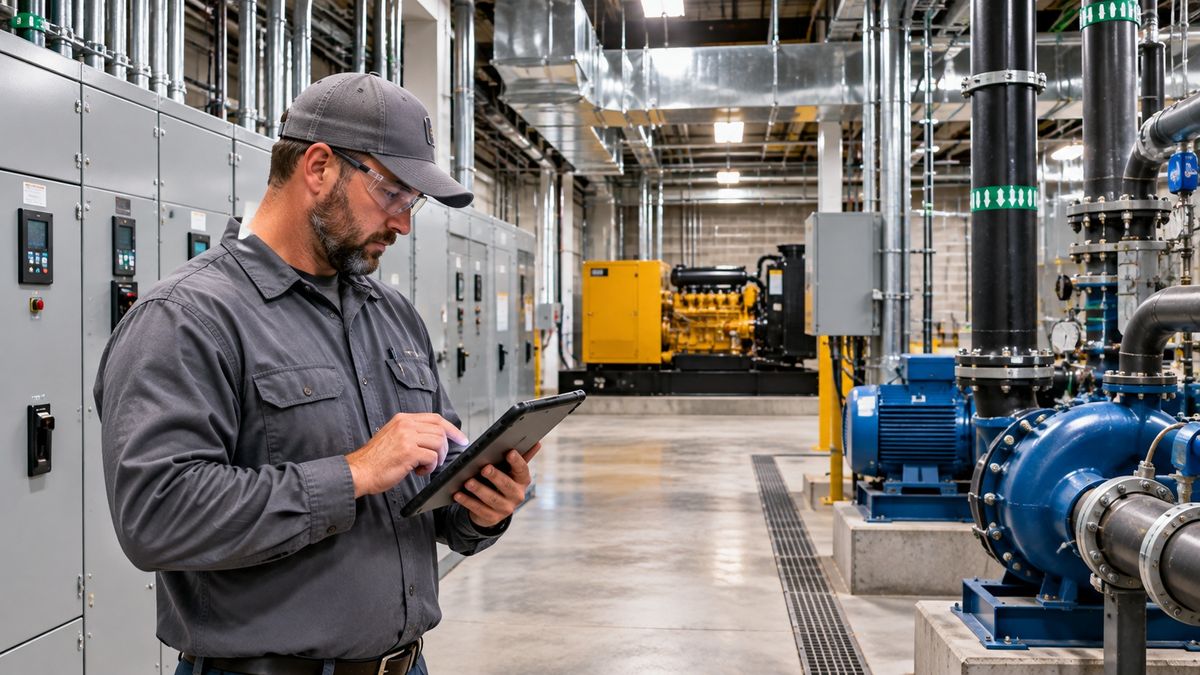
A preventive maintenance plan should do more than create a calendar of recurring tasks. For a critical facility, the plan needs to answer four questions clearly: What equipment matters most? What needs to be done? How often should it be done? And how will the facility know whether the work actually improved reliability?
That structure is especially important for facilities that depend on electrical distribution, emergency power, HVAC systems, pumps, controls, and other infrastructure that supports continuous operations.
The most effective plan is not necessarily the one with the most maintenance. It is the one that directs the right maintenance resources toward the assets with the greatest operational consequences.
1. Build a Complete Asset Inventory
Start with an inventory of the equipment and systems the facility is responsible for maintaining. At minimum, the list should identify the asset, location, manufacturer, model, serial number where applicable, age or installation date, and the system it supports.
For critical facilities, the inventory may include:
- Standby generators and associated fuel systems
- Automatic transfer switches
- Switchboards, switchgear, panels, breakers, transformers, and feeders
- UPS systems and batteries
- Commercial HVAC equipment and air-handling systems
- Condenser and evaporator coils
- Pumps, motors, and controls
- CRAC and CRAH support equipment
- Monitoring and alarm systems
- Other facility infrastructure that affects uptime, safety, environmental control, or continuity of operations
The asset inventory becomes the backbone of the maintenance plan. Without it, it is difficult to know what is being maintained, what is being missed, and where maintenance dollars are being spent.
2. Rank Assets by Criticality
Not every asset deserves the same maintenance strategy. Criticality ranking helps facility teams focus first on the equipment whose failure would create the greatest consequence.
Consider factors such as:
- Impact on life safety or code-required systems
- Impact on operations or production
- Availability of redundant equipment
- Time required to repair or replace the asset
- Availability of replacement parts
- Cost of failure or secondary damage
- Impact on temperature, power quality, communications, or other critical conditions
- Regulatory, insurance, manufacturer, or customer requirements
A simple high-medium-low ranking can be enough to start. The key is to distinguish equipment that must be reliable from equipment that can reasonably be allowed to run to failure.
3. Identify the Maintenance Requirements for Each Asset
Once assets are ranked, determine what maintenance is actually required. Sources can include manufacturer recommendations, equipment manuals, inspection history, applicable codes and standards, service-provider recommendations, operating environment, and the facility's own failure history.
For electrical equipment, NFPA 70B provides a framework for documented electrical maintenance programs, maintenance intervals, inspections, testing, and condition assessment.
The U.S. Department of Energy also recommends balancing reactive, preventive, predictive, and reliability-centered maintenance approaches rather than applying one strategy indiscriminately across an entire facility. See DOE's operations and maintenance guidance.
4. Set Maintenance Frequencies
Maintenance frequency should be based on more than a generic annual checklist. Intervals may need to account for equipment criticality, manufacturer guidance, environmental conditions, operating hours, age, previous deficiencies, failure history, and applicable standards.
A heavily loaded asset in a dusty industrial environment may need more attention than the same equipment in a cleaner, lightly loaded space. Likewise, an asset with repeated deficiencies may need shorter inspection intervals until the root cause is understood.
5. Define the Actual Work Scope
Avoid vague work orders such as 'inspect generator' or 'check electrical equipment.' A useful preventive maintenance task should define what the technician is expected to inspect, test, clean, measure, document, or verify.
Depending on the asset, a work scope might include:
- Visual condition inspection
- Cleaning and contamination removal
- Connection or component verification
- Fluid, belt, battery, filter, or consumable checks
- Operational testing
- Temperature, vibration, load, voltage, or other measurements where appropriate
- Alarm and control verification
- Photographic documentation
- Deficiency identification
- Recommended corrective action
6. Coordinate Maintenance Around Facility Operations
Critical infrastructure maintenance often affects more than the maintenance department. Work may require shutdown coordination, IT notification, operations approval, safety planning, escort requirements, access to secured spaces, or temporary redundancy.
Build those dependencies into the maintenance plan before work is scheduled. A technically correct maintenance task can still create unnecessary risk if the facility is not prepared for the work.
7. Document What Was Found, Not Just What Was Done
A completed work order that only says 'PM complete' provides very little value. The maintenance record should help the next technician, facility manager, and budget decision-maker understand the condition of the asset.
Useful records can include:
- Inspection findings
- Test results and measurements
- Before-and-after photographs
- Observed deficiencies
- Parts replaced
- Cleaning method or service performed
- Recommended repairs
- Priority level
- Follow-up date
TIIS uses this documentation-focused approach in services such as commercial HVAC coil cleaning, where before-and-after photographs, coil condition, observed deficiencies, and maintenance priorities can be recorded for facility planning.
8. Create a Corrective-Action Process
Preventive maintenance is only valuable if identified deficiencies lead to action. Every finding should have a clear path: monitor, repair, replace, investigate further, or accept the risk.
Assign responsibility, priority, target date, and status. Critical deficiencies should not disappear into an inspection report without a follow-up process.
9. Track a Small Set of Maintenance KPIs
A maintenance plan should become more useful over time. Tracking a few practical metrics can help facility leaders see whether the program is reducing reactive work and improving reliability.
Examples include:
- Percentage of preventive maintenance completed on time
- Number of emergency work orders
- Planned vs. unplanned maintenance hours
- Repeat failures by asset
- Average time to close critical deficiencies
- Downtime by system or asset
- Maintenance cost by asset or equipment class
IBM's current preventive-maintenance guidance also identifies metrics such as downtime, equipment failure frequency, maintenance costs, asset life, and work-order completion as useful measures of PM performance. See IBM's preventive maintenance checklist guidance.
10. Review and Improve the Plan
A preventive maintenance plan should be a living document. When an asset fails, investigate why. When inspections repeatedly find no issues, consider whether the frequency is appropriate. When a new asset is installed, add it to the program immediately. When operating conditions change, adjust the plan.
The goal is not maintenance for maintenance's sake. The goal is reliability, visibility, and better control over facility risk.
A Practical Starting Point for Critical Facilities
If your facility does not have a mature preventive maintenance program today, start with the most critical systems rather than trying to document everything at once.
Build the asset list, rank criticality, identify required tasks, establish frequencies, create clear documentation standards, and track corrective actions. Once that foundation is working, expand the process across additional systems.
Texas Industrial Infrastructure Services supports commercial, industrial, institutional, and mission-critical facilities through generator services, electrical services, commercial HVAC coil cleaning, and critical environment cleaning.
To discuss preventive maintenance priorities for your facility, contact TIIS.