
For a facility manager, an HVAC problem does not always announce itself with a failed compressor or a building full of uncomfortable occupants.
Sometimes the problem develops much more quietly.
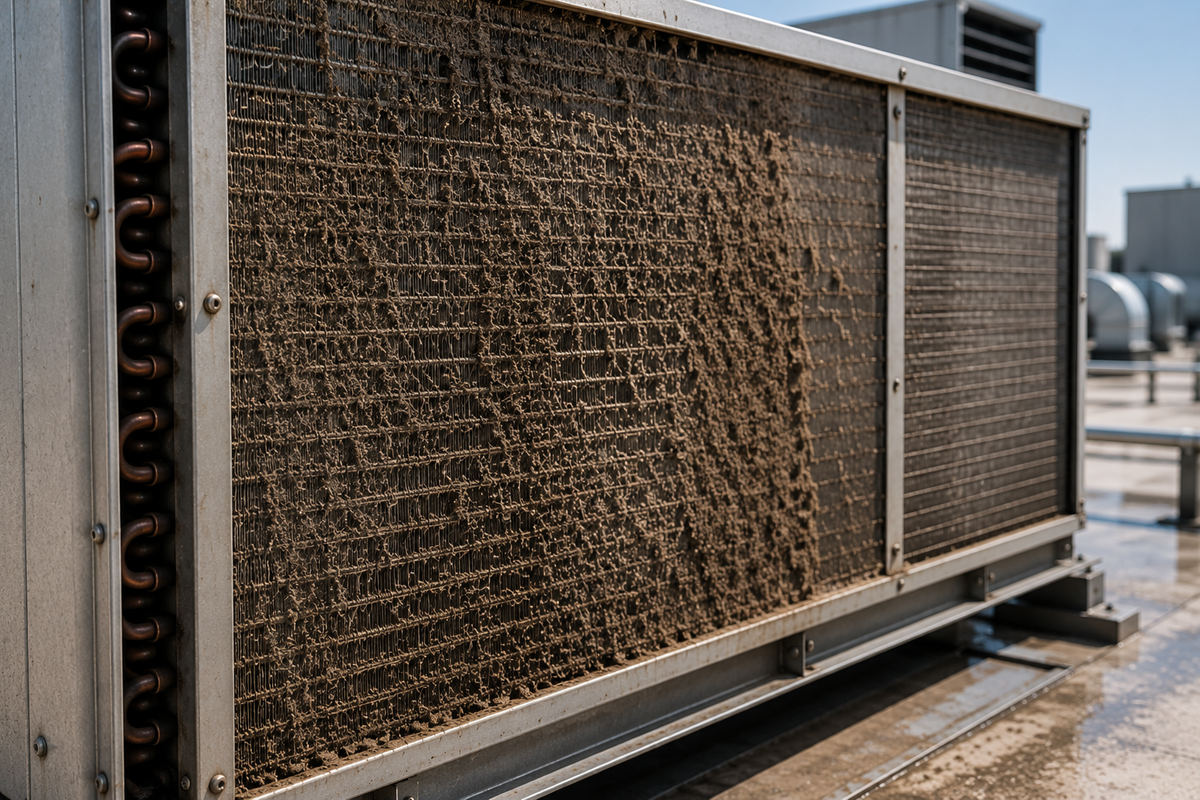
Dust, pollen, cottonwood, grease, construction debris, and other airborne contaminants gradually accumulate on condenser and evaporator coils. The equipment may continue to operate, but the buildup can interfere with two things the HVAC system depends on: airflow and heat transfer.
As coil surfaces become fouled, the system may have to operate longer and work harder to maintain the same conditions inside the facility.
The U.S. Department of Energy notes that dirt reaching heating and cooling coils can result in poor heat transfer and reduced equipment efficiency.
For commercial and industrial facilities, that makes coil condition more than a housekeeping issue. It is an infrastructure reliability issue.
Why Dirty HVAC Coils Matter
HVAC coils transfer heat between the air moving through the equipment and the refrigerant or water circulating through the system.
For that exchange to happen effectively, air needs to move across relatively clean heat-transfer surfaces.
Contamination creates a barrier.
Dirty surfaces can reduce heat transfer and restrict airflow. As a result, equipment may have to operate longer to meet the same cooling demand.
Depending on the equipment, operating conditions and severity of contamination, facility teams may encounter:
Longer equipment run times
Higher energy consumption
Reduced cooling performance
Additional strain on HVAC components
Restricted airflow
Difficulty maintaining comfortable indoor conditions
Increased equipment wear
The EPA's ENERGY STAR guidance also identifies dirty coils as a potential source of wasted energy and recommends inspecting and cleaning heating and cooling coils when necessary.
Routine commercial HVAC coil cleaning can help facility teams address this contamination as part of a proactive equipment maintenance strategy.
Dirty Coils Can Create a Hidden Energy Penalty
One of the challenges with coil contamination is that the equipment may continue running.
That can make declining performance easy to overlook.
A system that operates for longer periods to satisfy the same cooling demand can consume additional energy without producing an obvious maintenance alarm.
For a facility operating multiple rooftop units, air handlers or air-cooled chillers, performance losses can also be multiplied across numerous pieces of equipment and thousands of annual operating hours.
That is why TIIS approaches coil condition as part of a larger preventive maintenance strategy rather than waiting for an obvious HVAC failure.
This philosophy is consistent with the broader preventive approach discussed in Why Facility Managers Benefit from an Annual Maintenance Contract: identify and address developing equipment issues before they become larger operational problems.
Condenser Coils and Evaporator Coils Face Different Challenges
Both condenser and evaporator coils can become contaminated, but they operate in different environments.
Condenser Coils
Outdoor condenser coils are continually exposed to the surrounding environment.
Depending on the facility, contamination can include:
Dust
Pollen
Cottonwood
Leaves and organic debris
Construction dust
Landscaping debris
Industrial airborne contaminants
North Texas facilities can face particularly demanding conditions because commercial cooling equipment may operate extensively during prolonged periods of high temperatures while outdoor coils remain exposed to environmental contaminants.
Evaporator Coils
Evaporator coils generally operate inside HVAC equipment and receive some protection from filtration.
However, contaminants that make it through or around filtration can still accumulate on the coil.
The U.S. Department of Energy notes that poorly maintained filters can allow dirt to reach heating and cooling coils, contributing to poor heat transfer and reduced efficiency.
This is why inspecting actual coil condition matters.
A calendar alone cannot tell a facility manager how contaminated a particular coil has become.
What Equipment Can Have Coils That Need Cleaning?
Coils are used throughout commercial and industrial HVAC systems.
TIIS provides professional coil cleaning for equipment including:
Air Handling Units (AHUs)
Rooftop Units (RTUs)
Packaged HVAC Systems
Condenser Coils
Evaporator Coils
Air-Cooled Chillers
Make-Up Air Units
Commercial Heat Pumps
Industrial HVAC Equipment
The appropriate cleaning approach depends on the equipment, coil construction, contamination, accessibility and operating environment.
How Often Should Commercial HVAC Coils Be Cleaned?
There is no single cleaning interval appropriate for every commercial facility.
Operating conditions matter.
A relatively clean commercial office property may have very different requirements from a manufacturing plant, distribution facility, data center or building exposed to heavy pollen, cottonwood, dust or industrial contaminants.
Factors to consider include:
Equipment location
Operating hours
Outdoor environmental conditions
Filtration
Nearby vegetation
Construction activity
Industrial processes
Airborne grease or particulate
Previous maintenance history
The most effective approach is to inspect coil condition and establish maintenance priorities based on what the equipment actually needs.
What Does Professional Commercial Coil Cleaning Involve?
TIIS uses a four-step process designed around the equipment and facility rather than applying the same cleaning method to every coil.
1. Assess
Every cleaning begins with an inspection.
TIIS evaluates coil condition, airflow restrictions, fin condition, type of contamination, equipment access and site requirements.
2. Protect
Before cleaning begins, the team identifies components and surrounding areas that require protection.
Depending on the facility, that may include electrical components, adjacent equipment, roofing materials, interior finishes and sensitive operating environments.
For occupied facilities, containment and runoff planning can also be incorporated when necessary.
3. Clean
No two coils should automatically be cleaned the same way.
Depending on the equipment and contamination, TIIS may utilize dry steam, commercial coil-cleaning products, controlled low-pressure water or a combination of cleaning methods.
The objective is to remove contamination and improve the condition of the heat-transfer surface while protecting delicate coil fins and surrounding equipment.
4. Verify
The process does not end when the coil looks cleaner.
TIIS documents the completed work, including:
Before-and-after photographs
Coil condition
Cleaning method used
Observed deficiencies
Recommendations
Maintenance priorities
This documentation gives facility managers clearer records for ongoing maintenance planning.
Learn more about the TIIS commercial HVAC coil cleaning process.
Coil Cleaning Is Really About Reliability
A clean coil is not the ultimate objective.
Reliable infrastructure is.
For facility managers, HVAC performance can affect occupant comfort, equipment life, energy consumption, maintenance planning and the facility's ability to support the organization operating inside it.
Coil inspection and cleaning give facility teams another opportunity to identify deterioration before it contributes to a larger problem.
The broader objective is to understand equipment condition, document what is happening, address problems at the appropriate time and use that information to make better maintenance decisions.
That is the approach Texas Industrial Infrastructure Services brings to commercial HVAC coil cleaning and the larger infrastructure systems its customers depend on.
Are Your Commercial HVAC Coils Due for an Inspection?
If your facility's coils have not been inspected recently, or you're seeing signs of restricted airflow, longer equipment run times or declining cooling performance, the first step is understanding their current condition.
Request a Commercial HVAC Coil Assessment from Texas Industrial Infrastructure Services to discuss your equipment, operating environment and maintenance priorities.