
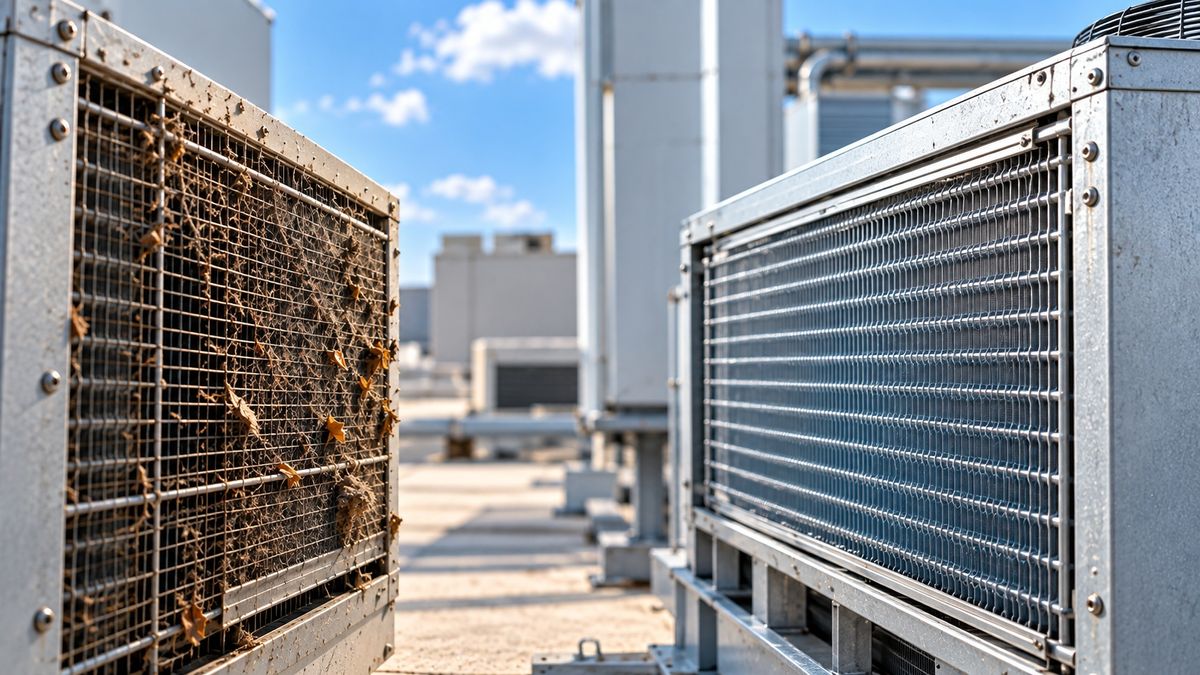
Commercial HVAC coils do not need to be completely blocked before contamination begins to affect system performance. Dust, lint, pollen, cottonwood, grease, and construction debris can collect gradually across coil fins, reducing the open area available for air to pass through the heat exchanger.
In many facilities, the first indication is not a visible failure. It is a change in how the system operates. Airflow may decline, temperatures may become harder to maintain, or equipment may run longer than it did under similar conditions.
These symptoms can have multiple causes, so they should not be treated as proof that a coil is dirty. But they are useful maintenance signals that can justify a closer inspection of the coils, filters, fans, dampers, ductwork, and other airflow-related components.
Here are five signs facility managers should watch for when evaluating whether commercial HVAC coils may be contributing to airflow restriction.
1. Reduced Airflow at Supply Registers or Through the Air Handler
One of the most direct warning signs is a noticeable decrease in airflow. An evaporator coil sits directly in the air path, so contamination on the fin surface or deeper in the coil can add resistance as air moves through the equipment.
ASHRAE guidance notes that coil airflow resistance is affected by coil geometry, moisture, and the aerodynamic cleanliness of the coil core. When contamination collects on the fins, the fan may need to work against greater resistance to move the same amount of air.
If airflow appears lower than normal, the coil should be considered as one possible restriction point along with clogged filters, closed dampers, fan issues, duct obstructions, and other system conditions.
2. Uneven Temperatures Across the Building
When airflow or heat transfer declines, maintaining consistent space temperatures can become more difficult. Some areas may feel warmer than expected while others remain comfortable, especially during high-load periods.
Uneven temperatures can be caused by many issues, including controls, balancing, duct design, occupancy, solar load, and equipment sizing. However, a fouled evaporator coil can contribute when it reduces the amount of conditioned air moving through the system or limits the coil’s ability to absorb heat effectively.
For facility teams, the key is to look for patterns. If comfort complaints increase at the same time airflow appears weaker or equipment run time increases, coil condition should be part of the inspection process.
3. Longer Equipment Run Times
A commercial HVAC system that runs longer to satisfy the same building load may be compensating for reduced heat-transfer performance. Dirty condenser coils can make it more difficult for the system to reject heat outdoors, while dirty evaporator coils can interfere with heat absorption and airflow indoors.
The U.S. Department of Energy has documented that dirty condenser and evaporator coils can reduce cooling capacity and cause compressors to work harder and longer. Longer cycles can also mean more operating hours for fans, compressors, and related components.
Run time should always be considered in context. Weather, occupancy, process load, thermostat settings, equipment staging, and control changes can all affect how long a unit operates. But a meaningful increase without an obvious operational explanation is worth investigating.
4. Rising Energy Use Without a Clear Change in Operations
Energy consumption naturally changes with weather and facility demand, but a sustained increase that cannot be explained by occupancy, production, operating hours, or utility-rate changes may indicate a system-efficiency issue.
When coils are fouled, the HVAC system may require more fan energy, longer compressor operation, or both to deliver the same result. The Department of Energy has identified coil cleaning as an important maintenance measure because contamination can inhibit both airflow and heat transfer.
Facility managers who track interval data, monthly utility usage, or equipment runtime trends may be able to spot these changes before they become obvious occupant-comfort problems. Energy data will not identify the cause by itself, but it can help determine where a physical inspection should begin.
5. Visible Buildup on the Coil Face or Around the Equipment
Sometimes the most useful sign is also the simplest: visible contamination. An outdoor condenser coil may show cottonwood, leaves, dust, grease, or other debris across the coil face. Around indoor equipment, facility teams may notice dirty filter sections, dust bypass, or material collecting on accessible evaporator-coil surfaces.
Surface buildup does not always reveal what is happening deeper inside a coil. A coil can look relatively clean from the entering-air side while contamination remains embedded within the fin pack. That is one reason visual inspection should consider the overall coil condition and, when accessible, both sides of the heat-transfer surface.
If the coil has not been inspected recently, TIIS recommends establishing a documented baseline. The process is discussed in How Often Should Commercial HVAC Coils Be Cleaned? A Facility Manager’s Guide.
Airflow Restriction Is a Symptom, Not a Diagnosis
Reduced airflow can result from dirty coils, but it can also be caused by filters, fans, belts, dampers, controls, duct conditions, blocked returns, or equipment problems outside the scope of coil cleaning. A responsible maintenance approach is to inspect the system and identify the actual restriction rather than assuming the coil is the cause.
TIIS coil-cleaning work begins with an assessment of coil condition, contamination, fin condition, access, and site requirements. If a project requires licensed HVAC repair, system modification, electrical work, refrigerant work, or another regulated service beyond the permitted scope of coil cleaning, TIIS coordinates with qualified licensed HVAC partners as appropriate.
What to Do When You Notice These Signs
If one or more of these warning signs appears, start by reviewing the basics: filter condition, recent maintenance history, building load changes, control settings, and visible coil condition. Compare current operating behavior with previous records if they are available.
Then document what you find. Before-and-after photographs, coil condition, observed contamination, cleaning method, maintenance concerns, and follow-up recommendations can help facility teams determine whether the problem is recurring and whether inspection intervals should be adjusted.
For a deeper look at how condenser and evaporator coils differ, see Condenser vs. Evaporator Coil Cleaning: What Facility Managers Need to Know.
Do Your Coils Need an Inspection?
Restricted airflow often develops gradually, which makes trend awareness and preventive inspection especially valuable. If your facility is seeing reduced airflow, uneven temperatures, longer run times, rising energy use, or visible coil contamination, the next step is to determine what is actually happening inside the equipment.
Texas Industrial Infrastructure Services provides commercial coil assessments and cleaning for approved condenser coils, evaporator coils, rooftop units, air-handling units, packaged systems, air-cooled chillers, and other commercial HVAC equipment. Request a commercial coil assessment to evaluate coil condition and determine an appropriate maintenance approach for your facility.