
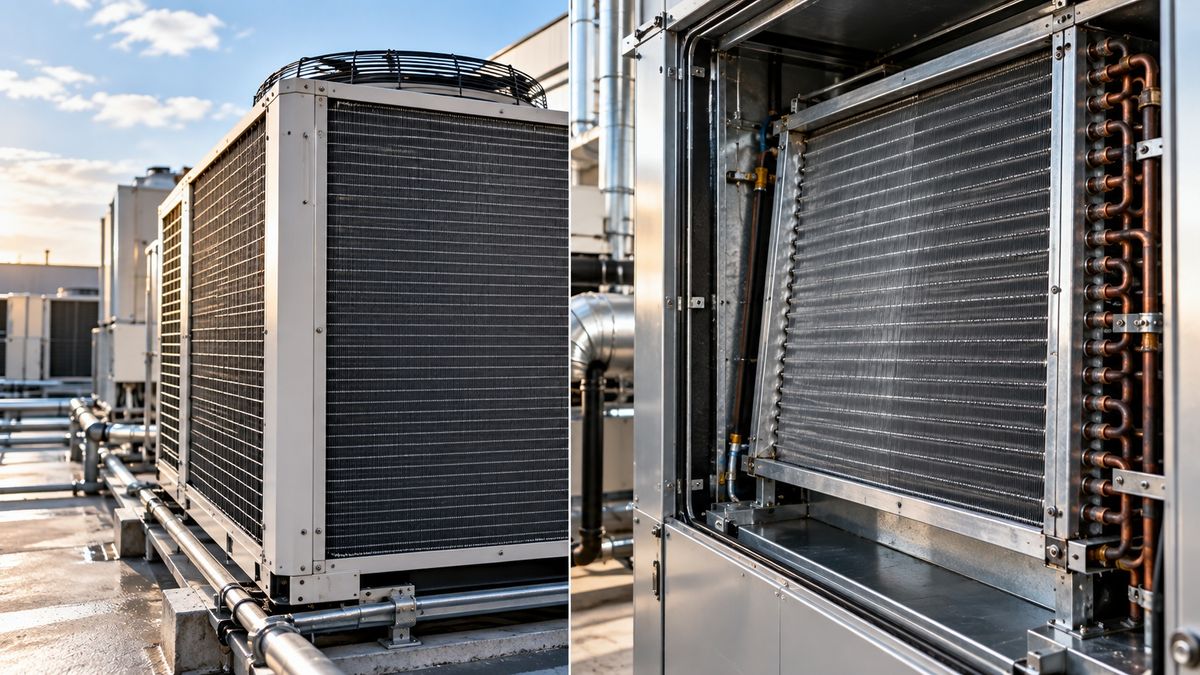
Condenser coils and evaporator coils are both heat-transfer surfaces, but they operate in different parts of a commercial HVAC system and are exposed to very different conditions. For facility managers, that distinction matters because the type of contamination, the symptoms of fouling, and the cleaning approach can differ from one coil to the other.
The common denominator is airflow and heat transfer. When coil surfaces become loaded with dust, pollen, grease, cottonwood, construction debris, or other contaminants, the system can have a harder time moving heat efficiently. The U.S. Department of Energy has long identified dirty condenser and evaporator coils as a source of reduced cooling capacity and increased compressor workload, while ASHRAE notes that coil cleanliness is important for maintaining full cooling capacity.
For facility teams, understanding the difference between the two coil types makes it easier to recognize where problems may be developing and when a commercial HVAC coil cleaning assessment may be appropriate.
What Does a Condenser Coil Do?
The condenser coil is part of the heat-rejection side of the HVAC system. In many commercial applications, it is located outdoors in a rooftop unit, condensing unit, air-cooled chiller, or other exterior equipment. Its job is to release heat that the refrigerant has carried out of the conditioned space.
Because condenser coils are commonly exposed to outdoor air, they can collect contaminants from the surrounding environment. Dust, pollen, leaves, grass clippings, cottonwood, exhaust residue, industrial particulate, and nearby construction debris can all accumulate on the coil face and between the fins.
As this material builds up, it can reduce airflow across the coil and interfere with heat rejection. The equipment may respond by operating longer or under greater load to maintain the required conditions. The U.S. Department of Energy has documented the relationship between dirty condenser coils, reduced cooling capacity, and increased power consumption.
What Does an Evaporator Coil Do?
The evaporator coil performs the opposite heat-transfer function. It absorbs heat from the air moving through the HVAC system so that cooled air can be delivered to the building. In commercial systems, evaporator coils are typically located inside air-handling equipment, rooftop units, or packaged systems.
Evaporator coils are generally more protected from outdoor debris than condenser coils, but they are not immune to contamination. Their condition can be affected by filtration performance, filter bypass, indoor dust, construction activity, grease, process contaminants, moisture, and biological buildup in certain environments.
A contaminated evaporator coil can create added resistance to airflow and reduce heat-transfer efficiency. ASHRAE notes that coil airflow resistance can be affected by coil cleanliness and recommends keeping coil surfaces clean so the equipment can deliver its intended cooling capacity. ASHRAE coil maintenance guidance also emphasizes inspection and appropriate cleaning when fouling or blockage develops.
Why the Cleaning Approach May Be Different
Although both coils need to remain clean, they should not automatically be treated the same way. Coil construction, fin condition, contamination type, equipment location, access, surrounding components, and operating environment all influence the appropriate cleaning method.
For example, an outdoor condenser coil may have a heavy layer of dry debris or cottonwood that needs to be removed without damaging the fins. An evaporator coil may have compacted dust deeper in the fin pack, moisture-related contamination, or access limitations inside an air-handling section. The objective is not simply to make the visible surface look clean. The objective is to improve coil condition while protecting the equipment and restoring airflow and heat-transfer surfaces as appropriate.
Depending on the equipment and contamination, TIIS may use dry steam, commercial coil-cleaning products, controlled low-pressure water, or a combination of methods. The process begins with an assessment so the cleaning method can be matched to the coil rather than applying the same procedure to every unit.
How Contamination Shows Up Differently
Condenser-coil problems often become visible from the exterior. Facility teams may notice a matted coil face, debris collecting around the unit, bent or clogged fins, or an unusually dirty surface. In a demanding outdoor environment, contamination can develop quickly even when the equipment is otherwise operating normally.
Evaporator-coil contamination can be less obvious because the coil is inside the equipment. Symptoms may instead appear as reduced airflow, uneven temperatures, longer run times, decreased cooling performance, or increased fan demand. These symptoms do not automatically prove the coil is dirty, but they are reasonable triggers for inspection.
If you are already seeing performance changes, TIIS outlines several common warning signs in 5 Signs Your Commercial HVAC Coils Are Restricting Airflow.
Should Both Coils Be Inspected?
In many facilities, yes. Looking at only one coil can provide an incomplete picture of system condition. A relatively clean evaporator coil does not mean the condenser coil is clean, and a clean condenser coil does not rule out internal airflow restrictions.
A more useful maintenance approach is to inspect both sides of the heat-transfer process and document what is found. This is especially important for facilities with long cooling seasons, 24/7 operations, heavy outdoor contamination, active construction, process dust, or limited maintenance history.
TIIS also recommends building a facility-specific maintenance history rather than relying on a one-size-fits-all cleaning interval. For more on that approach, see How Often Should Commercial HVAC Coils Be Cleaned? A Facility Manager’s Guide.
What Facility Managers Should Document
Whether the coil is a condenser or evaporator, documentation makes future maintenance decisions easier. A useful coil record should identify the equipment, coil location, observed contamination, fin condition, access limitations, cleaning method, before-and-after condition, and any maintenance concerns noted during the work.
Over time, this information can help facility teams identify which units foul more quickly, which environments create recurring contamination, and where inspection intervals may need to change. It also provides a clearer record when discussing equipment condition with internal maintenance teams or licensed HVAC contractors.
Condenser and Evaporator Coils Have Different Jobs, but the Same Maintenance Goal
Condenser and evaporator coils operate on different sides of the cooling process, but both depend on effective heat transfer and airflow. When contamination begins to interfere with either function, HVAC performance can suffer.
The most useful question for facility managers is not simply whether the coil looks dirty. It is whether contamination is beginning to restrict airflow, reduce heat transfer, or create additional operating strain.
Texas Industrial Infrastructure Services provides commercial coil cleaning for condenser coils, evaporator coils, rooftop units, air-handling units, air-cooled chillers, packaged systems, and other approved commercial HVAC equipment. Learn more about the TIIS commercial HVAC coil cleaning process or request a coil assessment for your facility.